What Is Narrow Aisle Storage and How Does It Work?

Time:2026-10-03 Author:Sienna
0%

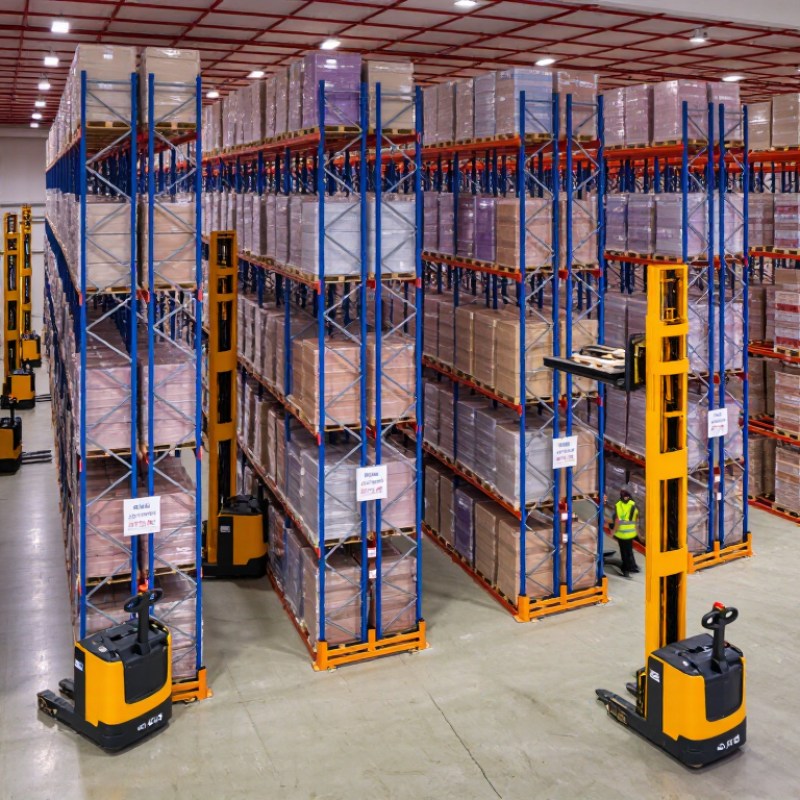
Narrow Aisle Storage changes how a warehouse uses every square meter. It reduces rack spacing, often to about 8–10 feet, while supporting selective, double-deep, or pallet-flow configurations. Specialized reach trucks can travel deeper between uprights. Their masts extend upward, not outward.

The practical question is not simply, “How many pallets fit?” It is, “Can operators retrieve them safely and consistently?” Warehouse & Distribution Science co-author Dr. John J. Bartholdi III states, “The objective of a warehouse is to provide a place to store inventory.” That principle sounds simple, but aisle design makes it complicated. Turning radius, rack height, floor quality, battery charging, and driver visibility all affect performance. One missed clearance can slow an entire shift.

Recent industry evidence supports a careful evaluation. MHI’s 2024 Annual Industry Report identifies labor pressure, service expectations, and technology adoption as major forces reshaping warehouse operations. WERC’s DC Measures 2024 report also emphasizes measurable performance, including productivity, space use, and order accuracy. Narrow Aisle Storage can improve cube utilization, but it may reduce maneuverability and demand more disciplined traffic control. More capacity is not automatically better.

This guide explains how narrow aisle systems work, where they fit, and what they cost operationally. It also examines reach trucks, very narrow aisle equipment, rack selection, and safety planning. Some layouts look efficient on paper. Real warehouses can disagree.
What Is Narrow Aisle Storage and How Does It Work?

Defining Narrow Aisle Storage and Its Core Purpose

Narrow aisle storage is a warehouse layout that places pallet racks closer together than standard systems. Its core purpose is to store more goods within the same floor area. Aisles may measure roughly 1.8 to 2.5 meters wide, depending on equipment and rack design. The exact width must follow operational tests, not guesswork.

Specialized lifting equipment moves through these tighter lanes. Operators can access pallets vertically while preserving valuable floor space. This arrangement supports higher storage density, clearer product zoning, and shorter walking distances. For example, a warehouse may reserve lower rack levels for fast-moving cartons and upper levels for reserve stock. Labels, lighting, floor markings, and accurate inventory records become essential.

The main advantage is space efficiency. However, narrow aisles do not automatically improve every warehouse. Equipment costs may rise, and poorly trained operators can slow picking or damage loads. A layout can look efficient on paper but fail during busy shifts. Supervisors should measure travel time, pallet access, safety clearance, and replenishment delays before changing the design. Regular inspections also matter because a small rack impact can affect an entire aisle. The system works best when storage density supports real workflow, rather than replacing it.

What Is Narrow Aisle Storage and How Does It Work?

Narrow aisle storage uses reduced aisle widths to increase pallet capacity within the same warehouse footprint. Compared with conventional layouts, it typically requires specialized lifting equipment and more precise operator control.

The chart uses representative industry dimensions: conventional aisles are commonly about 12–14 ft wide, narrow aisles about 8–10 ft, and very narrow aisles about 5–7 ft. Actual requirements vary according to rack design, pallet size, forklift type, and safety clearances.

Understanding the Main Components of a Narrow Aisle System

Narrow aisle storage uses reduced rack spacing to increase pallet capacity without expanding the building. Its core component is the upright rack frame, which carries vertical loads through columns and base plates. Horizontal beams support pallets at selected heights. Each level must match the pallet dimensions, load weight, and handling method. Small errors matter. An uneven floor can affect stability and vehicle movement.

The aisle is another essential component. It must provide enough clearance for the selected lifting equipment to turn, lift, and place pallets safely. Some systems use guided rails, induction wires, or visual markers to keep equipment aligned. Sensors and control systems can improve positioning, but they cannot replace trained operators or regular inspections. A narrow aisle plan is never perfect on paper. A layout may appear efficient, yet feel awkward during a busy shift.

Tips: Measure real pallet loads, not ideal samples. Check beam deflection, floor quality, lighting, and emergency access before installation. Leave practical tolerance around loads. Too little space slows work and increases contact damage. Review travel paths after several operating weeks; daily behavior often reveals weaknesses that drawings miss. Rack protection, clear labels, and scheduled inspections also help maintain reliable performance. Depth, height, and aisle width should be reviewed together. Changing one dimension can affect the entire storage system.

How Narrow Aisle Storage Operates Within a Warehouse

Narrow aisle storage operates by reducing the space between pallet racks, often from 12 feet to approximately 8–10 feet. This creates more storage locations without expanding the building. Specialized reach trucks or turret trucks move vertically, place pallets, and turn within limited clearance. Wire guidance, rail guidance, or floor markings help keep equipment aligned. The warehouse management system directs each task, while barcode scans confirm the pallet, location, and quantity.

The process depends on disciplined movement. A worker receives a task, travels to the assigned aisle, retrieves or stores a pallet, and records the transaction digitally. Rack height, load weight, turning radius, and battery capacity must match the equipment. Small errors matter. A misplaced pallet can block access and delay several orders. OSHA estimates that powered industrial trucks cause about 85 workplace deaths and 34,900 serious injuries annually in the United States. Therefore, speed cannot replace operator training, aisle controls, inspections, and pedestrian separation.

The efficiency is real.

MHI’s 2024 Annual Industry Report found that 55% of supply chain professionals planned to increase technology investment, supporting wider use of guided equipment and warehouse software. Yet narrow aisles are not automatically better. They may increase capacity while reducing flexibility for bulky products or sudden volume changes. A practical design should test actual travel paths, peak-hour congestion, and emergency access. Planning is rarely perfect. The layout must be reviewed after real operators use it.

Comparing Narrow Aisle Equipment and Accessibility Options

Narrow aisle storage uses reduced aisle widths to place more pallet positions within the same building. Instead of leaving wide turning areas, warehouses use specialized trucks that work within tighter spaces. This design can increase storage density, but it also demands accurate planning, trained operators, and consistent floor conditions.

Equipment choice directly affects accessibility. Reach trucks suit selective pallet storage and can handle different rack heights with reasonable flexibility. Very narrow aisle turret trucks offer excellent vertical access, but they usually need guided aisles and carefully maintained floors. Articulated forklifts can enter narrow spaces from wider travel aisles, reducing the need for extensive guidance systems. Order-picking equipment supports manual access to individual cases, although it may lower picking speed for heavy goods.

Aisle width is only one accessibility measure. Check turning clearance, rack beam height, pallet dimensions, lighting, and emergency access. Operators also need clear sightlines and safe pedestrian separation. Small errors become noticeable quickly. A slightly undersized aisle can create repeated repositioning, damaged loads, and slower shifts. In one practical review, a denser layout looked efficient on paper but restricted maintenance access. That flaw mattered more than the extra pallet positions. Accessibility should be tested with real equipment, real loads, and actual operator movement before installation.

What Is Narrow Aisle Storage and How Does It Work? - Comparing Narrow Aisle Equipment and Accessibility Options

Storage or Equipment Option Typical Clear Aisle Width Typical Working Height Access Method Pallet Access Space Utilization Best-Suited Applications Main Accessibility Considerations
Standard Selective Pallet Racking 3.0–3.7 m
(9.8–12.1 ft)
Commonly up to 7.5–9 m
(24.6–29.5 ft)
Conventional counterbalance or reach truck Direct access to every pallet location Moderate; prioritizes accessibility over maximum density High-SKU warehouses, mixed pallet sizes, frequent picking, and operations requiring simple stock rotation Generally the easiest layout for vehicle maneuvering, operator visibility, and emergency access
Narrow Aisle Reach-Truck System 2.4–3.0 m
(7.9–9.8 ft)
Often up to 10–12 m
(32.8–39.4 ft)
Reach truck with extendable forks and a tighter turning radius Direct access to each pallet location High; reduces aisle space while retaining selective access Distribution centers seeking greater pallet capacity without moving to highly specialized equipment Requires trained operators, carefully controlled travel paths, and floor conditions suitable for precise truck operation
Very Narrow Aisle Turret-Truck System 1.5–2.0 m
(4.9–6.6 ft)
Frequently up to 12–18 m
(39.4–59.1 ft)
Guided turret truck with forks that rotate to either side Direct access to both sides of the aisle Very high; rack rows can be placed close together High-throughput, high-bay facilities with large numbers of pallet locations Usually needs aisle guidance, smooth and level floors, specialized training, and strict control of rack and pallet tolerances
Double-Deep Pallet Racking 3.0–3.7 m
(9.8–12.1 ft)
Typically up to 9–10 m
(29.5–32.8 ft)
Reach truck or specialized double-deep attachment Direct access to the front position; rear pallet access requires moving the front pallet High; adds storage depth and reduces the number of aisles Operations holding several pallets of the same product or using planned batch storage Lower selectivity than single-deep racking; inventory placement and retrieval sequences must be managed carefully
Drive-In or Drive-Through Racking One truck lane per block; aisle needs depend on truck type Commonly up to 8–10 m
(26.2–32.8 ft)
Forklift enters storage lanes supported by rails Limited; pallets are stored in depth and are not individually accessible Very high cube utilization Large quantities of the same SKU, low product variety, and dense cold or ambient storage Requires compatible pallets, accurate driving, impact protection, and careful control of loading and unloading sequences
Carton Flow or Pallet Flow Racking Service aisle commonly 2.4–3.7 m
(7.9–12.1 ft)
Varies by rack design and load type Manual picking or forklift loading; rollers move products toward the pick face Front-facing access with FIFO or LIFO options depending on configuration High for fast-moving inventory; improves pick-face density Order picking, date-sensitive goods, case storage, and products requiring organized stock rotation Needs accurate load dimensions, compatible containers or pallets, replenishment planning, and clear pedestrian separation
Mobile Pallet Racking One active aisle can be about 2.7–3.7 m
(8.9–12.1 ft)
Often comparable to selective pallet racking Motorized rack bases open an aisle only where access is required Direct access when the selected aisle is open Very high; minimizes fixed aisle space Temperature-controlled storage, archival inventory, and facilities where floor area is expensive Access depends on rack movement; requires safety interlocks, floor capacity checks, emergency release procedures, and controlled traffic
Automated Storage and Retrieval System System-specific; storage aisles may be approximately 1.2–2.0 m
(3.9–6.6 ft)
Can exceed 20 m
(65.6 ft), depending on system design
Automated cranes, shuttles, or lifts controlled by warehouse software System-directed access; individual pallet retrieval is possible when configured for it Extremely high potential density and vertical utilization High-volume, predictable operations requiring traceability, reduced manual travel, or extended operating hours Requires significant planning, reliable power and controls, maintenance access, safety guarding, and manual-recovery procedures

Planning note: Actual aisle requirements depend on truck dimensions, load size, rack geometry, turning clearance, floor flatness, fire protection, building columns, and local safety regulations. Confirm final dimensions with an equipment and rack-layout assessment before installation.

Evaluating Space Savings, Efficiency, and Operational Requirements

Narrow aisle storage reduces travel space between pallet racks, often from 10–12 feet to 6–8 feet. That change can create 20–40% more pallet positions, depending on rack height, column spacing, and building shape. The number is not guaranteed. Every site behaves differently.

MHI’s 2024 Annual Industry Report found that 55% of supply-chain professionals planned to increase technology investment. Narrow aisle systems support that goal, but only when equipment matches the workflow. Specialized lift trucks need accurate steering, stable floors, clear rack protection, and trained operators. Battery charging also requires dedicated space. Small delays become expensive. WERC’s 2024 DC Measures Report reinforces this concern by separating capacity, labor productivity, and order-cycle performance. More locations do not automatically mean faster fulfillment. A picker may save storage space but lose time searching higher levels or waiting for equipment.

Operational planning should examine SKU velocity, pallet weights, replenishment frequency, and emergency access. High-volume products may need wider aisles or forward-pick areas. Slow-moving inventory can tolerate greater density. Fire protection and local building requirements must also be checked before installation. The calculation is often imperfect. A projected 30% space gain may disappear if congestion increases or pallets require frequent retrieval. Measure actual travel time, not just the rack drawing. Data from several weeks is more useful than one optimistic simulation.

FAQS

What is narrow aisle storage?

Narrow aisle storage places pallet racks closer together than standard layouts. It increases storage capacity within the same floor area.

How wide are narrow aisles?

Aisles often measure about 1.8 to 2.5 meters wide. The correct width depends on equipment, rack design, and turning clearance. Do not guess.

What equipment operates in narrow aisles?

Specialized reach trucks or turret trucks move vertically between racks. Guidance rails, floor markings, or wire systems can improve alignment. Trained operators remain essential.

How does the system improve warehouse efficiency?

Higher racks create more pallet locations without expanding the building. Shorter walking distances can also support faster picking. Lower levels may hold fast-moving cartons.

What must be checked before installation?

Measure actual pallet weights, dimensions, and floor conditions. Check rack height, beam strength, lighting, emergency access, and turning space. Small errors matter.

Can narrow aisle storage work for every warehouse?

No. Bulky products and sudden volume changes may need wider access. A layout can look efficient on paper but fail during busy shifts.

How does technology support narrow aisle operations?

Warehouse software assigns tasks and records pallet locations. Barcode scans confirm the item, position, and quantity. Technology helps, but it cannot replace judgment.

What safety practices are important in narrow aisles?

Separate pedestrians from lifting equipment whenever possible. Train operators, inspect racks regularly, and protect exposed corners. One small impact can affect an entire aisle.

How should performance be reviewed after installation?

Measure travel time, pallet access, congestion, and replenishment delays. Watch real operators during peak periods. Daily behavior may reveal weaknesses that drawings miss.

Conclusion

Narrow Aisle Storage is a warehouse organization method designed to increase storage capacity by reducing the space between racking rows. Its core purpose is to make better use of available floor area while maintaining a practical system for storing, locating, and retrieving inventory. A typical setup includes vertical storage racks, compatible lifting equipment, guided travel paths, safety features, and an inventory management process that supports accurate movement of goods.

Within the warehouse, operators use specialized equipment to access pallets or containers positioned at greater heights and in tighter aisles. Different equipment and accessibility options can be selected according to load size, rack height, turning requirements, and workflow demands. Compared with conventional layouts, Narrow Aisle Storage can provide significant space savings and improve inventory density, but it also requires careful planning, trained operators, suitable floor conditions, and well-defined traffic and safety procedures. Its effectiveness depends on balancing storage capacity with accessibility, handling speed, maintenance needs, and the operational requirements of the facility.

Sienna

Sienna

Sienna is a skilled marketing professional with a deep expertise in our company’s core products and services. With a passion for innovation and detail, she plays a pivotal role in crafting insightful blog posts that not only highlight the unique features of our offerings but also provide valuable......